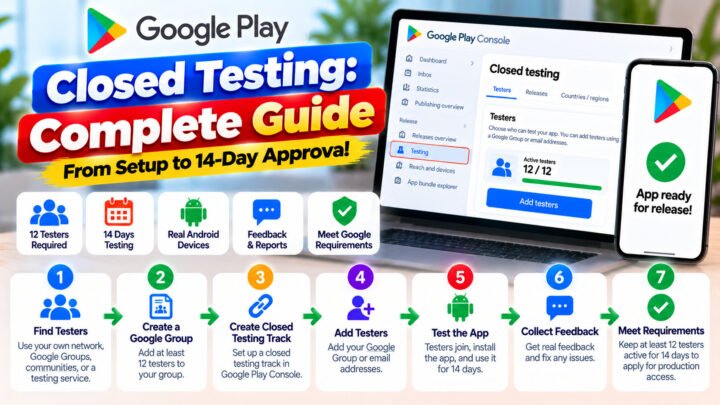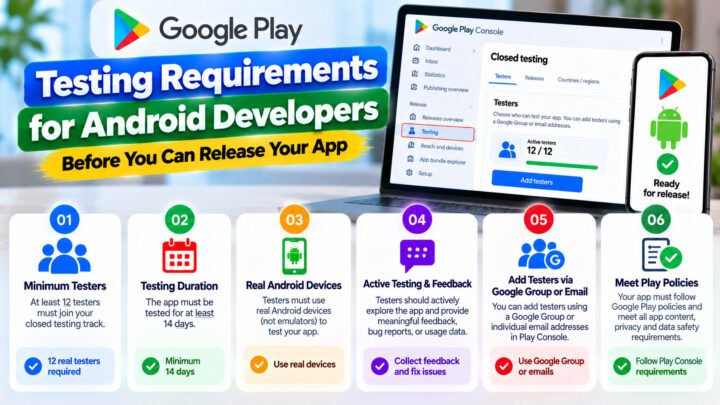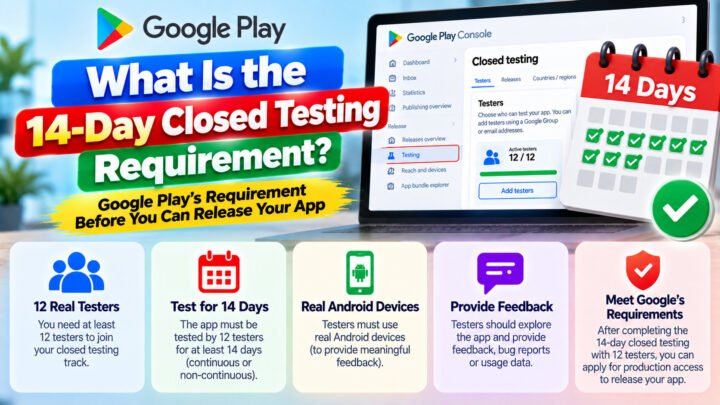









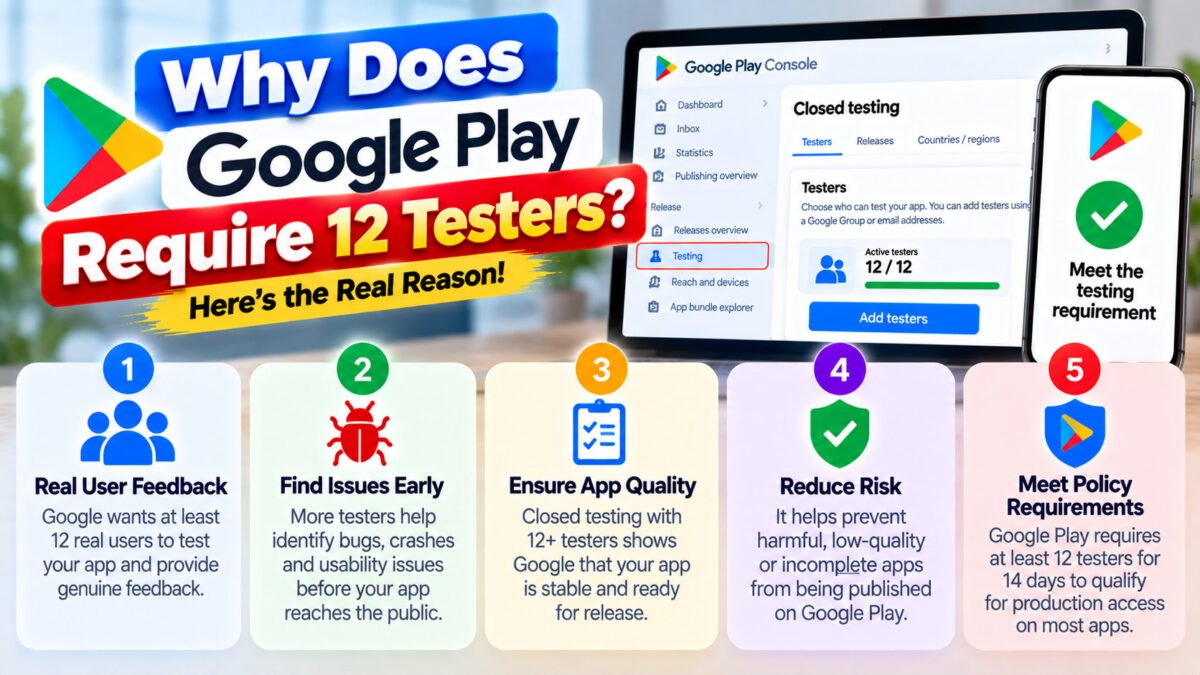
Twelve is a strange-looking number. Not ten, not twenty, not “as many as you like”. Developers ask about it constantly, and the honest answer has three parts: why Google introduced a testing gate at all, why the number is where it is, and what it means for how you should run your test.
The problem Google was solving
Before the rule, a personal developer account could publish straight to production. The result was predictable: a flood of low-effort apps, cloned content, apps that crashed on launch, and a support burden split between Google and users. Play Store quality signals — uninstall rate, crash rate, ratings — were being polluted at the source.
Google’s response was to require evidence that someone other than the developer had actually used the app before it reached the public store. Closed testing was the chosen mechanism because it is private, measurable, and runs through Play itself, so Google can see precisely who installed what, on which device, and for how long.
Why 12, and why 14 days?
Twelve testers is roughly the point where a single test group stops being noise. A handful of installs on one phone tells you about one device, one Android version and one set of usage habits. Twelve real testers across different devices, manufacturers and Android versions starts to surface the failures that matter: the crash that only happens on one OEM’s build, the layout that breaks on a small screen, the sign-in flow that fails on an old WebView.
The 14-day window addresses a different class of bug. Memory leaks, battery drain, notification failures, sync errors and background-service problems rarely appear on day one. They appear after a week of ordinary use. Two weeks is long enough for those issues to show up and short enough to keep the process usable for a small team.
Both numbers are continuously evaluated. Twelve testers is not a one-time registration — it is a requirement that has to hold every day, or the consecutive-day counter restarts. See how the 14-day requirement works.
What the reviewers actually see
When you request production access, your request does not land in a vacuum. The account has a testing history: how many testers were opted in, on what devices, whether installs stayed, whether the app was opened, whether updates were published, and what you answered on the questionnaire.
This is the part developers underestimate. Meeting the numeric gate is necessary but not sufficient. Two tests can both show “12 testers, 14 days” and look completely different:
- One has stable engagement, published updates, and a questionnaire describing feedback that was implemented.
- The other has twelve accounts that installed once, no activity since, no new builds, and a questionnaire that says everything worked.
The second one gets scrutinised, and refusal at that stage costs you another full two-week cycle.
What this means for your test
Three practical conclusions follow from the reasoning above:
- Start with more than 12. The buffer is what protects the consecutive-day chain, which is the part Google actually measures.
- Use real devices and real accounts. Emulators and duplicate accounts are exactly what the policy was designed to filter out; they put the whole test at risk rather than saving you effort.
- Publish updates during the window. A build history is evidence that testing happened. Silence looks like a ticked box.
Does the requirement apply to everyone?
No. The hard 12-tester, 14-day gate applies to personal (individual) developer accounts registered on or after 13 November 2023. Organisation accounts — verified businesses — follow a different process and can be exempt from the tester count.
Most indie developers are on personal accounts, and the rule applies per app: every new app on the same personal account has to pass the same gate. That is why developers who publish repeatedly end up building a reusable tester group rather than recruiting from scratch each time.
Frequently asked
Do testers have to be in my country?
Testers can be anywhere, provided the country is included in your app’s testing country list. Wider geography actually helps — more device variety, fewer shared-network flags.
Can I use the same testers for my next app?
Yes, and you should. A Google Group of people who already know the routine turns a two-week recruitment problem into a one-afternoon task.
What if a tester uninstalls on day 10?
Get them back the same day. If the opted-in count stays at 12 you are fine; if it dips to 11, the consecutive-day counter restarts from the moment you are back at 12.
Keep reading
- Google Play closed testing: the complete guide
- How to get 12 testers
- The 14-day requirement, explained
- Testing requirements for Android developers
If the arithmetic of “12 testers, every day, for 14 days” is the part you would rather delegate, TesterPilot supplies and monitors the testers for you — see the plans or message us on WhatsApp.