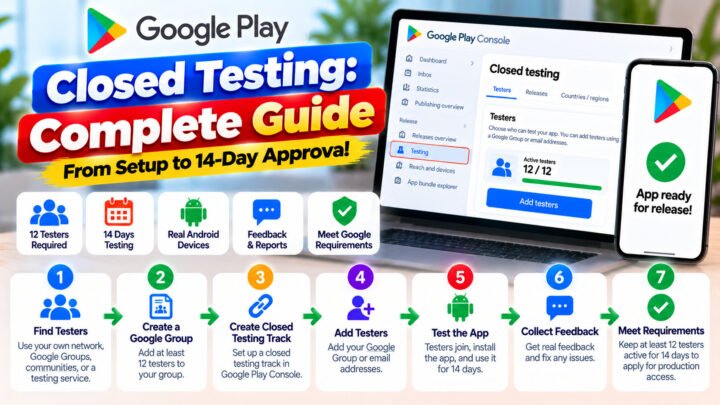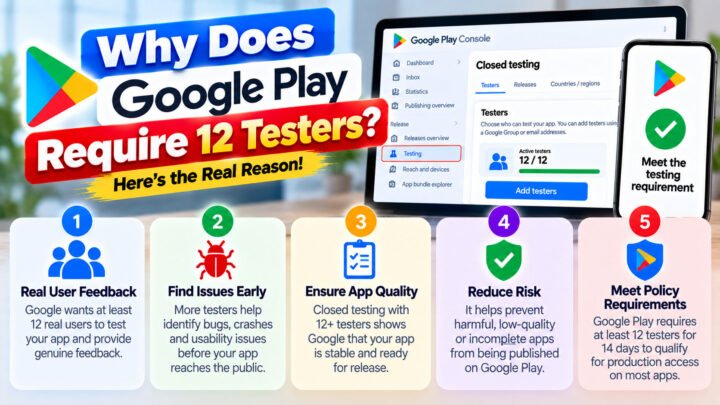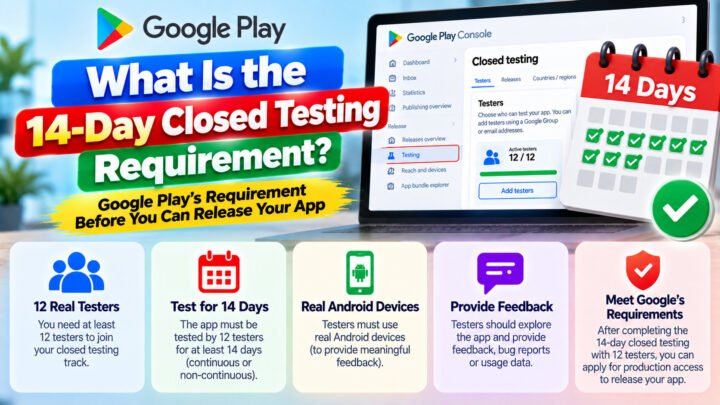









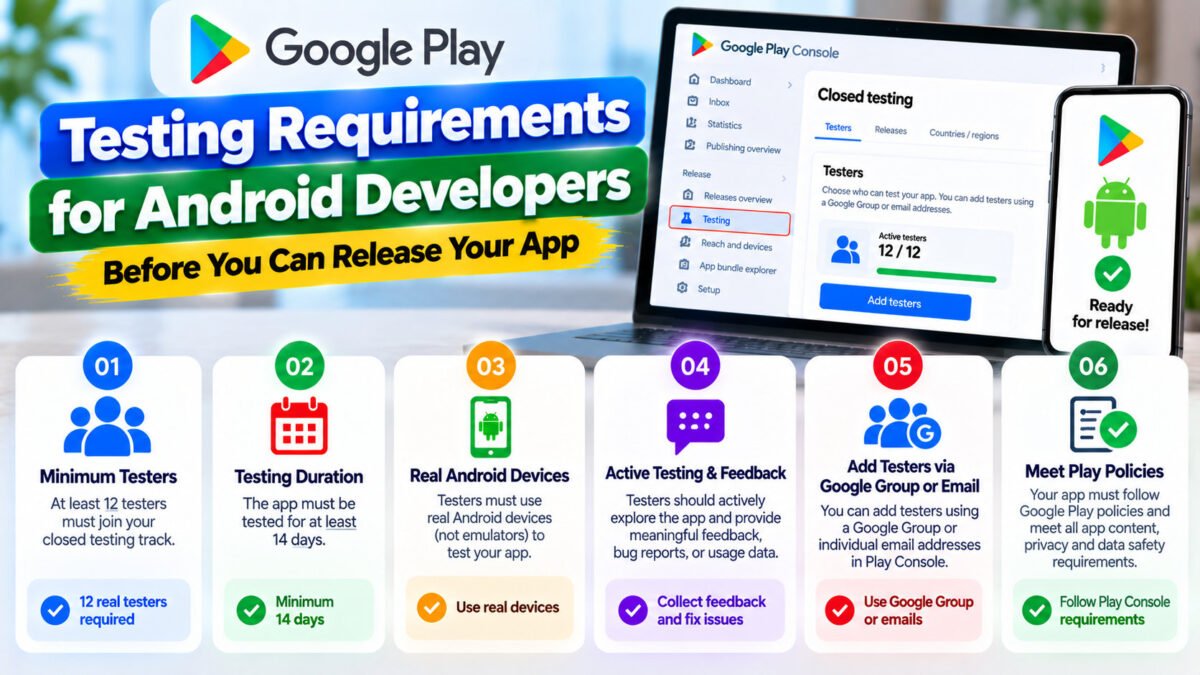
This is the reference page: everything Google Play requires of your testing process before production, in one place. Facts change, so check Play Console’s own help pages before making irreversible decisions — but this is the shape of it as developers experience it today.
Developer account types
| Account type | Testing requirement before production |
|---|---|
| Personal (individual), registered on or after 13 Nov 2023 | Closed test with 12+ testers opted in for 14 consecutive days, then apply for production access |
| Personal (individual), registered earlier | Not subject to the tester gate |
| Organisation (business) | Exempt from the tester count; production access follows a declaration/verification process |
The requirement applies per app: a second app on the same personal account needs its own 12 testers and its own 14 days.
The testing numbers
- Minimum 12 testers opted in, simultaneously.
- 14 consecutive days at or above 12 opted-in testers.
- Only the Closed testing track counts. Internal and open testing do not substitute.
- Testers must be real Google accounts on real Android devices. Emulators do not count.
- Testers install via the opt-in link and Google Play, not from a sideloaded APK.
If the opted-in count drops below 12, the consecutive-day counter restarts. Because of that, plan for 15–20 testers rather than exactly 12. Details: the 14-day requirement.
App and listing requirements
These are not testing rules, but they block the same door:
- AAB uploaded to the track, release published (not draft).
- Store listing complete: app name, short description, full description, at least 3 screenshots, feature graphic, and the 512×512 icon.
- Content rating questionnaire completed.
- Data safety form completed, accurately — mismatches with your privacy policy are a common policy failure.
- Privacy policy URL, live and reachable.
- Target API level meeting Google’s current requirement for new apps.
- Testing countries include every country your testers are in.
The production-access review
Once the numbers are met, you apply from the Closed testing track and answer a questionnaire about tester numbers, device coverage, the feedback you received and how you acted on it. Reviewers can see opt-in counts, device diversity, engagement and your build history — so they judge whether a real test happened, not just whether a counter reached 14.
Most refusals come from: thin engagement, an incomplete listing, unresolved policy warnings, or app stability. How to apply for production access covers the answers.
What you should prepare before day one
- Testers. 15–20 committed people with real devices. Where to find them.
- A Google Group so future apps reuse the same pool instead of restarting recruitment.
- A published closed track with countries configured. Track setup.
- A finished listing. Do this before you recruit, not after day 14.
- A daily check habit. Thirty seconds a day prevents two-week restarts.
- A record of findings. You will need them for the questionnaire — and a written testing report makes that trivial.
Timeline to expect
| Stage | Typical duration |
|---|---|
| Recruiting 15–20 testers | A day to several weeks, depending on the route |
| Closed test (the counted window) | 14 consecutive days |
| Applying for production access | An hour to write properly |
| Review decision | A few days, occasionally longer |
| Production rollout | Same day to a week with staged rollout |
Realistically: three weeks from a finished build to production, if nothing resets. Two months if testers drop out twice.
Mistakes that cost the most time
- Starting with exactly 12 testers.
- Using internal testing and expecting it to count.
- Recruiting before the store listing is complete.
- Not checking the opted-in count daily.
- Recreating the track when a build needs fixing.
- Applying with vague answers.
- Believing a rejection means starting over — it does not. Keep the test, fix the cause, reapply.
Related guides
- Google Play closed testing: the complete guide
- Why Google Play requires 12 testers
- Closed testing vs internal testing
- What happens after 14 days
If you would rather not spend three weeks recruiting and monitoring testers, TesterPilot supplies 12+ real testers, monitors the streak daily and sends a written testing report you can quote in your production-access application. See the plans or message us on WhatsApp.